Upcoming Webinar: Introducing Arena-flow on the Siemens APA
CPFD Software and Siemens will jointly host an upcoming webinar on April 8, 2026, 8 AM Central, to introduce Arena-flow, now available through the Siemens Advanced Partner Alliance.

CPFD Software and Siemens will jointly host an upcoming webinar on April 8, 2026, 8 AM Central, to introduce Arena-flow, now available through the Siemens Advanced Partner Alliance.
CPFD Software is pleased to announce a direct distribution and collaboration agreement with ASK Chemicals Japan Co., Ltd.
CPFD Software is pleased to once again sponsor and participate in the SPE-GCS Annual Symposium. Saurav Mitra of CPFD Software will present “AI-Accelerated Reduced-Order Modeling for Dense Gas/Liquid-Solid Flows Using Barracuda Virtual Reactor (MP-PIC): An Industrial Perspective.”
In this webinar, we will present the Cement Calciner Decomposition Furnace Application Model, which uses Barracuda Virtual Reactor to simulate an industrial-scale calciner. The model captures the coupled gas–solid hydrodynamics, coal combustion, devolatilization, and limestone calcination within a fully compressible, reacting multiphase flow framework.
This installment in the series will focus on the Direct Reduced Iron Shaft Furnace Application Model, which provides a detailed digital twin of a full-scale DRI shaft furnace based on operating data from a commercial plant in Quebec, Canada. The model captures key process zones, including cooling, reducing, and transition regions, using a moving bed framework with compressible flow, volumetric and discrete reaction chemistry, and user-defined reaction kinetics.
CPFD Software (CPFD) is pleased to announce that it has entered into a software licensing agreement with Alléo Energy for use of CPFD’s Barracuda Virtual Reactor fluid-particle simulation software. Alléo…

Also available on Youtube. About This Webinar Presented by: Tanner Stelmach – CFD Engineer CPFD Software’s Barracuda Application Model Webinar Series is designed to give engineers and researchers deeper insight…
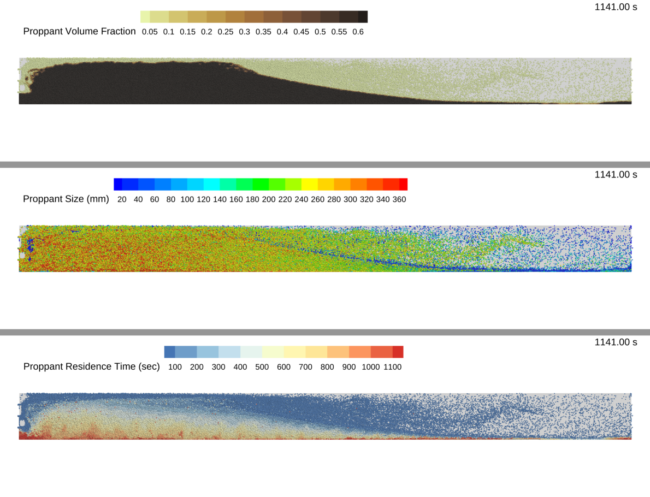
This application model uses Barracuda Virtual Reactor to simulate proppant transport and bed formation within a single hydraulic fracture using the Multiphase Particle-in-Cell (MP-PIC) method. A non-Newtonian drag correction accounts for the shear-thinning behavior of the slickwater carrying the proppant, and the resulting settling and bed formation behavior are validated against the single-fracture experimental measurements of Zhou et al. (2023). The simulation captures the heel-skewed bed geometry and particle size segregation that govern how much of the fracture remains conductive after treatment. This validated CFD solution also serves as the benchmark for a Graph Neural Network reduced-order model (GNN-ROM), demonstrating a pathway toward fast, physics-based proppant transport prediction at the scale of full multi-fracture completions.
This study evaluates the injection of secondary air above the dense bed as a cost-effective means of controlling the problem. Barracuda has been used to track the complex fluid dynamics and interaction of phases with particle size distribution effects. The 3D reactor model accounts for kinetics, heat and mass transfer, and mixing effects during the coke combustion process in a regenerator and maps the gas phase composition.
This work presents a Graph Neural Network (GNN)–based Reduced Order Modeling (ROM) framework for Barracuda that achieves approximately 80–105× speedup for transient and time-averaged field predictions, respectively, and up to three orders of magnitude speedup for isolated snapshot queries, while preserving predictive accuracy