Introducing Arena-flow by CPFD to the Siemens APA
Also available on Youtube. About This Webinar CPFD Software and Siemens jointly hosted a partner webinar on April 8, 2026 to introduce Arena-flow®, now available through the Siemens Advanced Partner…

Also available on Youtube. About This Webinar CPFD Software and Siemens jointly hosted a partner webinar on April 8, 2026 to introduce Arena-flow®, now available through the Siemens Advanced Partner…

CPFD is pleased to be a speaker, exhibitor and sponsor at tcbiomass+2026. Join us for this year’s conference.
CPFD Software is proud to announce that it has joined the American Foundry Society (AFS).
Beijing Hi-key Technology Co. Ltd., CPFD Software’s distributor for Barracuda Virtual Reactor in the People’s Republic of China, has announced a series of online and in-person training courses for 2026
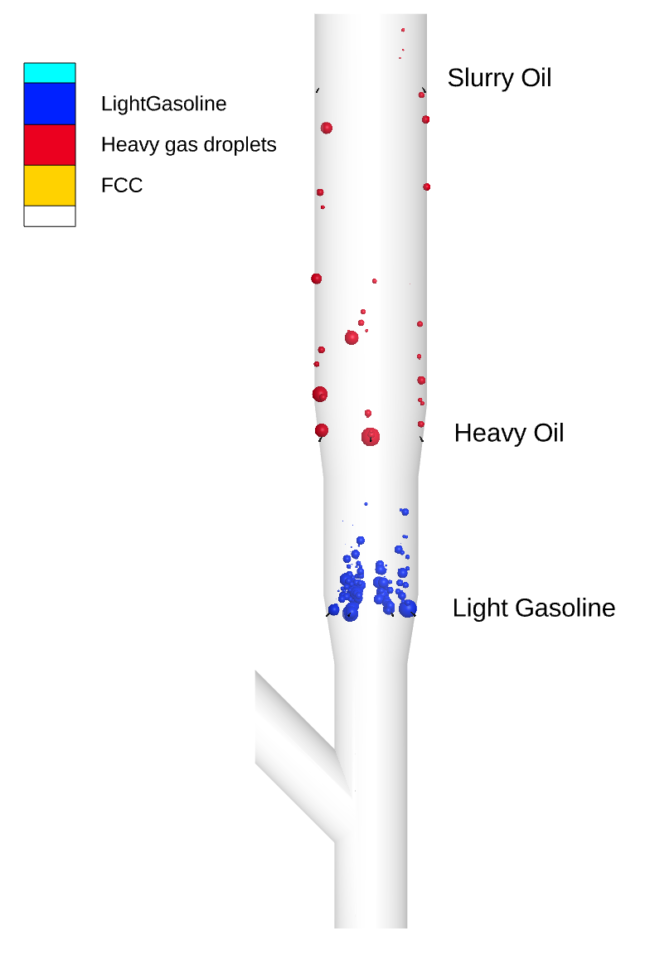
Fluid Catalytic Cracking (FCC) units are the beating heart of modern oil refineries, providing exceptional value by converting low-value heavy hydrocarbon fractions into high-demand products like gasoline, diesel, and olefins. Within the FCC riser reactor, pre-heated liquid feed is atomized and injected into a turbulent stream of hot, fluidized zeolite catalyst, initiating rapid endothermic cracking reactions. The complex vapor-liquid-solid hydrodynamics, extreme conductive and convective heat transfer, and rapid feed evaporation in this zone directly dictate operational success. Incomplete vaporization severely hampers catalytic efficiency, accelerating unwanted thermal cracking, excessive coke formation, and long-term equipment degradation.
This application model uses Barracuda Virtual Reactor to simulate an industrial-scale FCC riser, focusing on the critical vaporization dynamics of multi-component feed droplets interacting with a dense catalyst flow. Based on the staged-injection configuration of Berrouk et al. (2017), the model captures the distinct reaction environments created by lower-elevation light gas feeds, mid-elevation mixed temperature control (MTC) heavy gas oil injections, and higher-elevation slurry oil quenching. To accurately resolve the varying volatility of real FCC feedstocks, the simulation incorporates a newly developed API correlation-based Python tool that translates True Boiling Point (TBP) curves and Watson K factors into high-resolution, temperature-dependent material properties for the evaporating droplets.
Results demonstrate the detailed evaporation profiles of liquid droplets over the height of the riser, highlighting how individual hydrocarbon cuts vaporize at varying rates based on their unique boiling point distributions. The model illustrates the intense thermal gradients and momentum transfer near the injection nozzles, showing how staged feeding successfully manipulates local temperatures to prevent the over-cracking of lighter species while ensuring heavy oils receive sufficient headroom to vaporize.
This application model provides a practical foundation for studying FCC riser hydrodynamics, evaluating multi-component feed vaporization, mitigating thermal cracking and coke buildup, and optimizing injection strategies to maximize catalytic efficiency and refinery yield.
Introduction Decarbonization of the global energy industry has become a central focus of both academic research and global economic strategy, as the sector strives to meet rapidly increasing demand and…
CPFD Software and Siemens will jointly host an upcoming webinar on April 8, 2026, 8 AM Central, to introduce Arena-flow, now available through the Siemens Advanced Partner Alliance.
CPFD Software is pleased to announce a direct distribution and collaboration agreement with ASK Chemicals Japan Co., Ltd.
CPFD Software is pleased to once again sponsor and participate in the SPE-GCS Annual Symposium. Saurav Mitra of CPFD Software will present “AI-Accelerated Reduced-Order Modeling for Dense Gas/Liquid-Solid Flows Using Barracuda Virtual Reactor (MP-PIC): An Industrial Perspective.”
In this webinar, we will present the Cement Calciner Decomposition Furnace Application Model, which uses Barracuda Virtual Reactor to simulate an industrial-scale calciner. The model captures the coupled gas–solid hydrodynamics, coal combustion, devolatilization, and limestone calcination within a fully compressible, reacting multiphase flow framework.