Fluidized Bed Technologies in Korea
Also available on Youtube. About This Webinar Presented by Prof. Seehoon Lee of Jeonbuk National University at the 2026 Emerging Fluidization Applications Workshop, hosted by CPFD Software and KWT Solution.…

Fluidization research is conducted with the goal of better understanding the underlying physical phenomena occurring within a fluidized bed, such as particle-fluid momentum transfer, particle collisions, and chemical reactions. While CPFD’s Barracuda Virtual Reactor is designed for industrial-scale simulations, the easy-to-use interface and fast simulation times make Barracuda Virtual Reactor a valuable tool within a research setting to design experiments, analyze and regress data, and apply findings to the improvement of industrially-significant fluidized systems.
“We get much more out of our experiments when we compliment them with the CFD modeling, specifically CPFD Software, Barracuda. We have a better understanding of what’s going on. It allows us to see what we can’t see experimentally. And we get more value for our data because of it.”
Dr. Ray Cocco, President, Particulate Solid Research Inc.
Typical applications for Virtual Reactor in a research setting are:
Simulation vs Experiment for Geldart Group B Particles
Presentation: How PSRI Streamlines Our Work Process using Barracuda
Simulation vs Experiment for Geldart Group A Particles
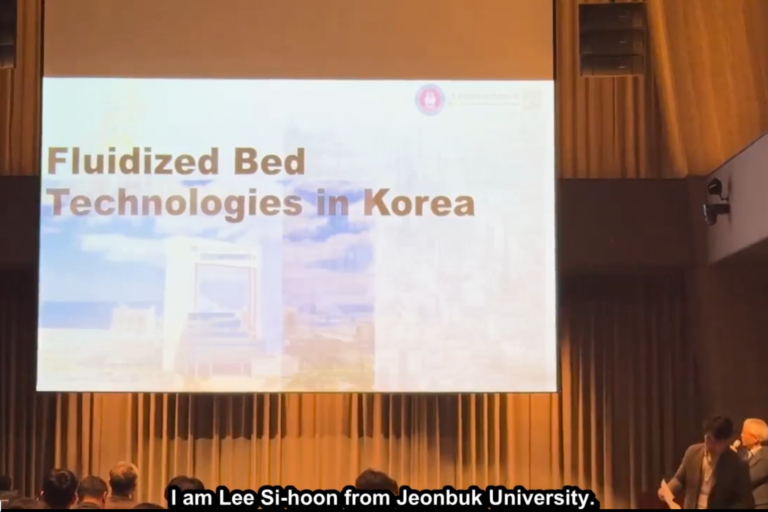
Also available on Youtube. About This Webinar Presented by Prof. Seehoon Lee of Jeonbuk National University at the 2026 Emerging Fluidization Applications Workshop, hosted by CPFD Software and KWT Solution.…
This study by Cesar Medina-Pedraza and Hugo de Lasa of the University of Western Ontario reports a numerical hybrid cluster CPFD simulation of a downer reactor unit.
Researchers from NETL use Barracuda simulation and ECVT data to explore suitability of different modeling techniques to capture effects of a perforated distributor plate.
A novel solids separator for a chemical looping reactor was designed at NETL using Barracuda Virtual Reactor, and the final as-built separator performed well.
Experimental operation of three fluidized bed processors is compared with CFD simulation results by Parker, Williams, and Thibault, CPFD Software, and LaMarche, Chen, and Stamato, Bristol-Myers Squibb Company.
This paper by Ray Cocco, S. B. Reddy Karri, Yeook Arrington, Roy Hays, John G. Findlay, and Ted Knowlton of PSRI discusses the simulation-informed development of a conical jet cup device that allows all of the sample particles to experience similar solids stresses.