Use of pressure to mitigate gas bypassing in fluidized beds of FCC catalyst particles
This publication demonstrates that pressure fluctuations and local bubble void fraction can diagnose gas bypassing
A comprehensive experimental database for travelling fluidized bed model testing is extended
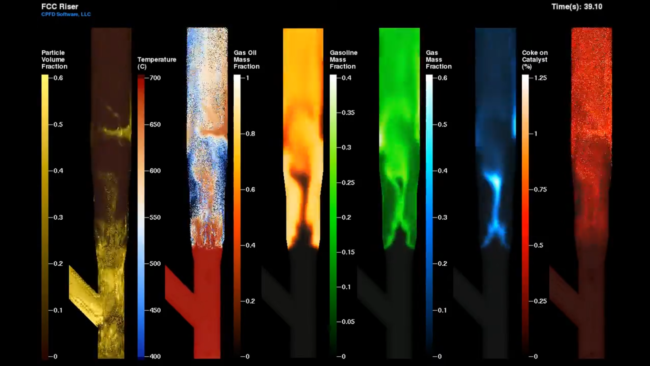
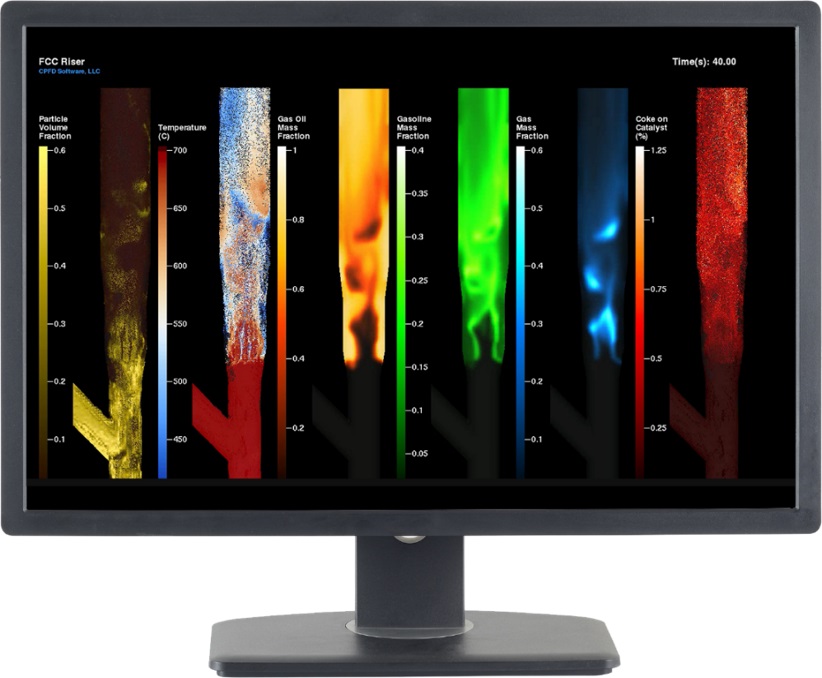
This video shows the transient, 3D modeling of the thermal and reacting flows inside an FCC riser located on the Arabian Peninsula.
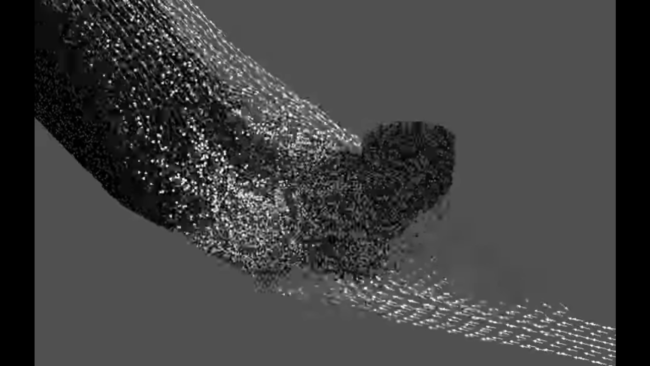
This video shows the transient engagement of densely-loaded spent FCC catalyst exiting from the standpipe into a lift riser for transport into an FCC regenerator.
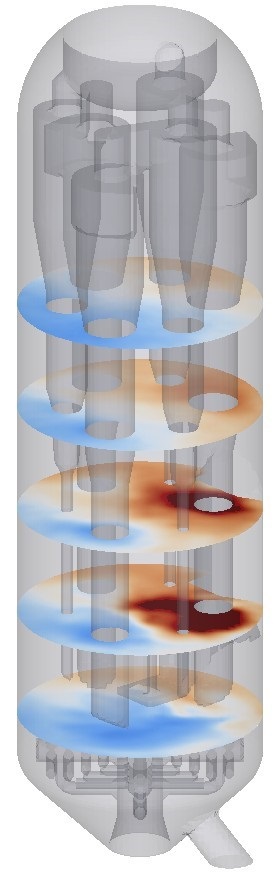
This animation was part of a study conducted by a North American refiner using the Barracuda Virtual Reactor to understand and correct the high levels of carbon monoxide (CO) being produced in their FCC regenerator.
This video shows Barracuda Virtual Reactor® simulations results on the left, compared with large-scale test data from Particulate Solid Research, Inc. (PSRI) on the right.
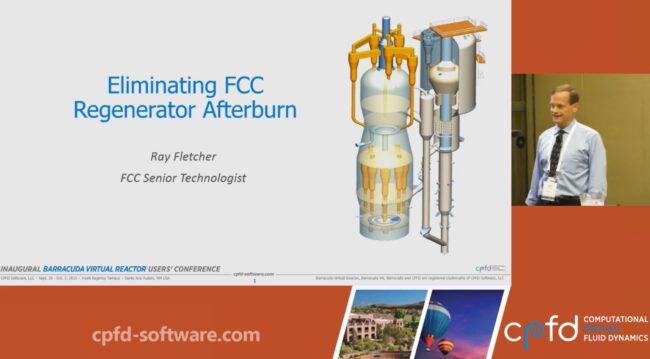
A model of a full-scale fluidized catalytic cracking (FCC) regenerator using the Eulerian-Lagrangian CPFD method in Barracuda VR. This video illustrates the use of the Barracuda Virtual Reactor to predict the 100°F afterburn observed at the refinery.
Engineers from CPFD and MPC report on the use of Barracuda to perform virtual testing on potential redesigns of FCC reactor internals at MPC’s Catlettsburg Refinery.
A model of a full-scale fluidized catalytic cracking (FCC) regenerator using the Eulerian-Lagrangian CPFD method in Barracuda VR.
This paper presents new capabilities and proof-testing of a collisional model previously presented in O’Rourke, Zhao, and Snider (2009) applied to liquid injection into a dense-phase fluidized bed.