
Strategies to Improve 3D Simulation Accuracy Using 1D Simulation for CFB Boilers
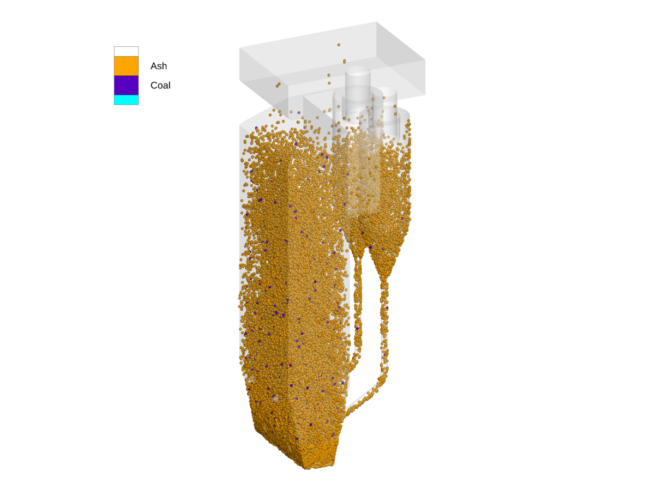
This presentation by Uendo Lee presents a strategy for improving the accuracy of 3D simulation using 1D simulation for CFB boilers.

This presentation by Uendo Lee presents a strategy for improving the accuracy of 3D simulation using 1D simulation for CFB boilers.
This paper by Dimitri Gidaspow is useful as a reference for engineers in industry and as an advanced level text for graduate engineering students.
Fluidization Engineering, Second Edition, by Kunii and Levenspiel, expands on its original scope to encompass these new areas and introduces reactor models specifically for these contacting regimes.
Also available on Youtube. About This Presentation Presented by Raj Singh, Technip Energies at the 2022 Barracuda Virtual Reactor Users’ Conference. Summary Computational modeling plays an increasingly important role in…
This report from Los Alamos National Lab (LANL) documents the KIVA-II computer program for the numerical calculation of transient, two- and three-dimensional, chemically reactive fluid flows with sprays.
This paper by Smagorinsky establishes some of the foundational equations for understanding particle-fluid physics.
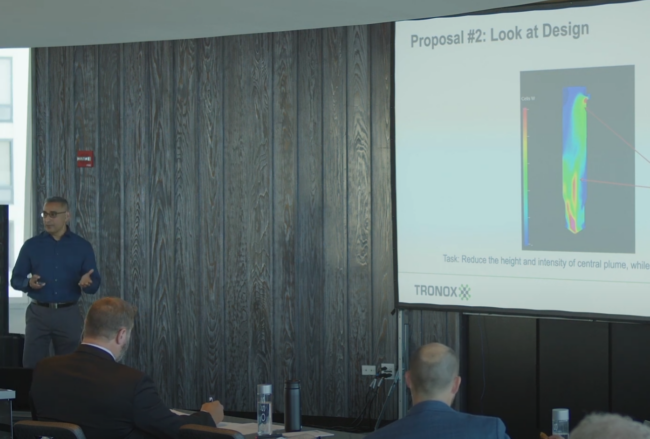
Also available on Youtube. About This Presentation Presented by Sibashis Banerjee of Tronox at the 2022 Barracuda Virtual Reactor Users’ Conference. Summary This talk will cover the use of modeling…
This presentation by Song Wang at the 2022 Barracuda Virtual Reactor Users’ conference discusses Encina’s fluidized bed catalytic pyrolysis reaction system which converts post-consumer plastics to valuable products.
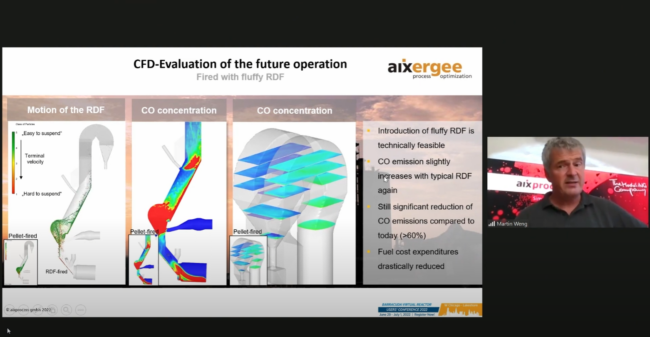
This presentation by Martin Weng discusses how the Barracuda Virtual Reactor was used to de-risk the modification of a German cement plant.
This application model uses Barracuda Virtual Reactor to simulate solid particle erosion in a 90-degree elbow, capturing particle-wall impacts and wear patterns under varying mass loadings. The simulation demonstrates how particle collisions influence erosion severity and distribution, enabling evaluation of component durability in particulate-laden flows.