Tecplot for Barracuda Training Videos
This collection of training videos will help Barracuda Virtual Reactor users get started with Tecplot for Barracuda. Some of the videos have been created by CPFD to highlight items of specific…

This collection of training videos will help Barracuda Virtual Reactor users get started with Tecplot for Barracuda. Some of the videos have been created by CPFD to highlight items of specific…
This paper demonstrates the effectiveness of the numerical method used by Barracuda Virtual Reactor – the multiphase particle-in-cell (MP-PIC) method, which allows a detailed simulation of even large-scale units with affordable computational efforts.
This video is part of the Tecplot for Barracuda Training Videos collection. This training video shows how to launch Tecplot for Barracuda from within the Barracuda Virtual Reactor GUI. The…
This thesis by Christopher McIntyre from the University of Ottawa explores the use of CPFD modeling related to pressurized chemical looping combustion.
Known Issues main page Barracuda Virtual Reactor 17.4.1 Issues fixed in this version: KI-125: Create support file does not work on Windows KI-126: CUDA errors when running on V100 GPU…
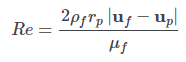
The particle Reynolds number, Re, is a common term used in many drag models. As discussed in the Particles chapter of Users Manual, in Barracuda the particle Reynolds number is…
In this paper, researchers demonstrate Barracuda Virtual Reactor’s ability to accurately model the relationship between particle size distributions and the hydrodynamics of pneumatic conveying systems by comparing simulation results to experimental data.
This joint paper by the China University of Petroleum and SINOPEC is part two in a two part series on the effects of internals on FCC regenerator performance.
Known Issues main page Barracuda Virtual Reactor 17.4.0 Issues fixed in this version: KI-92: Injection BC Tracers will not be fed if no particle species is defined KI-98: Discrete chemistry…
Known Issues main page Barracuda Virtual Reactor 17.3.1 Issues fixed in this version: KI-72: Solver allocates excess RAM at t=0 in GPU mode KI-99: Buffer OVERFLOW when writing GMV file…