Using Initial Conditions from File to Start a Simulation
This post shows how to start a Barracuda Virtual Reactor simulation from an Initial Condition (IC_*) file. It is possible to do many interesting and useful things that are not…

This post shows how to start a Barracuda Virtual Reactor simulation from an Initial Condition (IC_*) file. It is possible to do many interesting and useful things that are not…
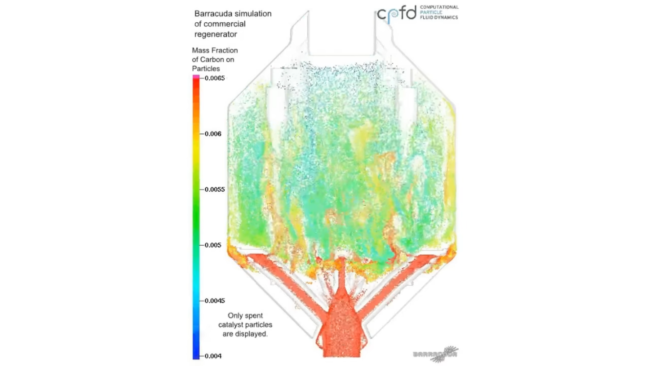
A model of a full-scale fluidized catalytic cracking (FCC) regenerator using the Eulerian-Lagrangian CPFD method in Barracuda VR.
This post shows how to restart simulations in Barracuda Virtual Reactor. When running Virtual Reactor simulations, there are several situations when a simulation may need to be restarted: The simulation…

This simulation shows how 3D simulations performed in Barracuda Virtual Reactor can be validated not just through rigorous experimental measurement, but also by 1D simulation of boundary conditions.
There are times when a Flow BC will not be perfectly aligned with the three major axes. In order to place the Flow BC correctly, direction vectors can be used…

This video demonstrates how Eulerian-Lagrangian methods such as the MP-PIC model and CFD-DEM can effectively simulate a full loop fluidized bed.
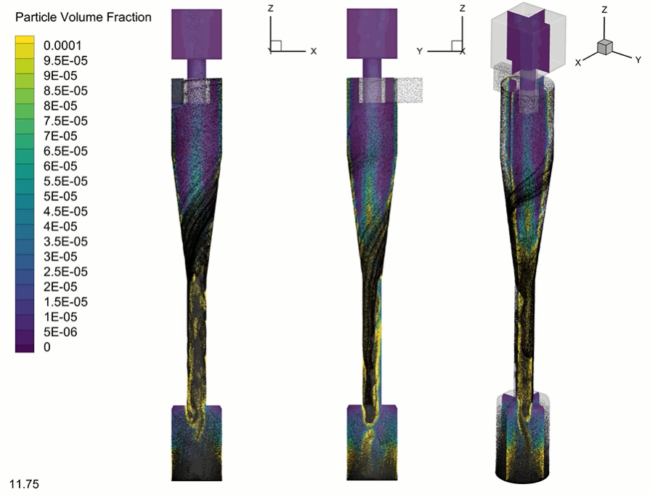
This video of a cyclone simulation demonstrates the use of Tecplot 360 to perform advanced analysis of results from Barracuda Virtual Reactor.
Tracers can be used to track fluid flow and fluid residence time in a simulation. Tracers are Lagrangian entities that do not have any mass or volume, and they follow…
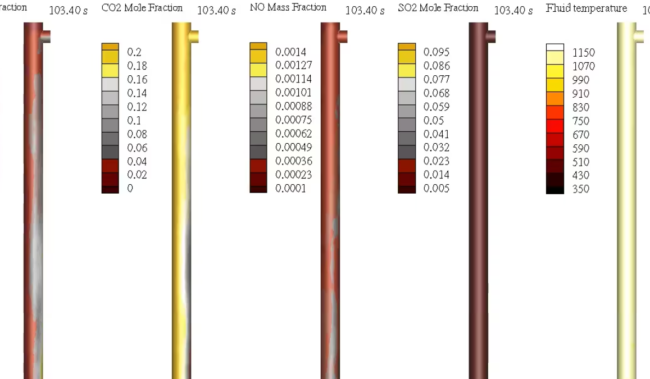
This video is part of set of simulations for a novel, fluidised-bed-based plastic recycling system. In this simulation, particle flow through an L valve is studied.
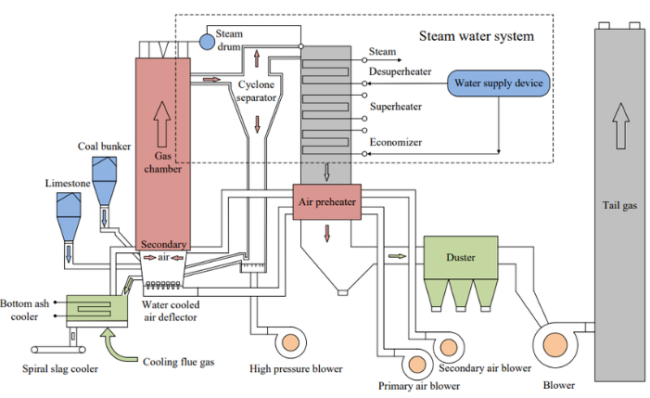
This video, from the CFBC Application Model, shows the initial fluidization of particles in the riser as well as the distribution of coal particles in the system.