
Application Model Overview
TRISO (TRi-structural ISOtropic) fuel particles are a key technology for next-generation high-temperature gas-cooled nuclear reactors (HTGRs), offering improved safety, higher operating temperatures, and enhanced fuel integrity compared to conventional nuclear fuels. During fabrication, carbon and silicon carbide coatings are deposited onto fuel kernels inside spouted bed chemical vapor deposition (CVD) reactors, where complex gas–solid hydrodynamics, heat transfer, reaction kinetics, and particle growth behavior directly influence coating quality and process efficiency.
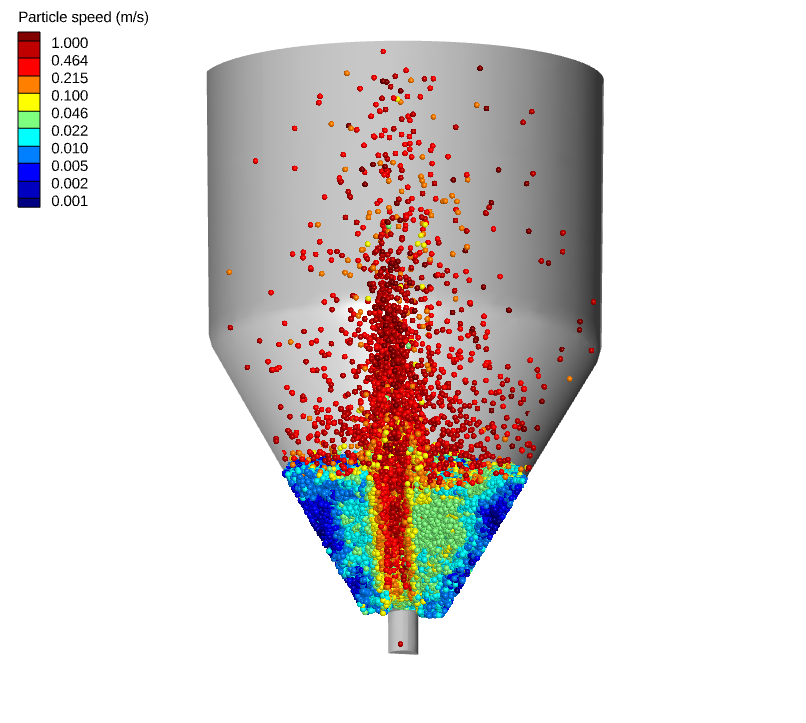
This application model uses Barracuda Virtual Reactor to simulate TRISO particle production within a 3D spouted bed reactor operating under acetylene pyrolysis conditions. The model captures dense particle fluidization and spouting behavior alongside hydrocarbon pyrolysis chemistry, soot precursor formation, and carbon deposition onto UO2 fuel kernels. A reduced but physically representative reaction network is used to model gas-phase species evolution and particle coating growth under high-temperature operating conditions.
Results demonstrate realistic transient and steady-state coating behavior, including rapid initial deposition, gradual stabilization of growth rates as hydrogen accumulates in the reactor, and the development of particle-to-particle coating variability over time. The model also illustrates how changes in particle density during coating can significantly increase entrainment losses, highlighting the importance of balancing deposition conditions with hydrodynamic stability.
This application model provides a practical foundation for studying TRISO coating reactor design, particle growth behavior, deposition uniformity, entrainment mitigation, and process optimization for advanced nuclear fuel manufacturing workflows.
Additional Resources