
Application Model Overview
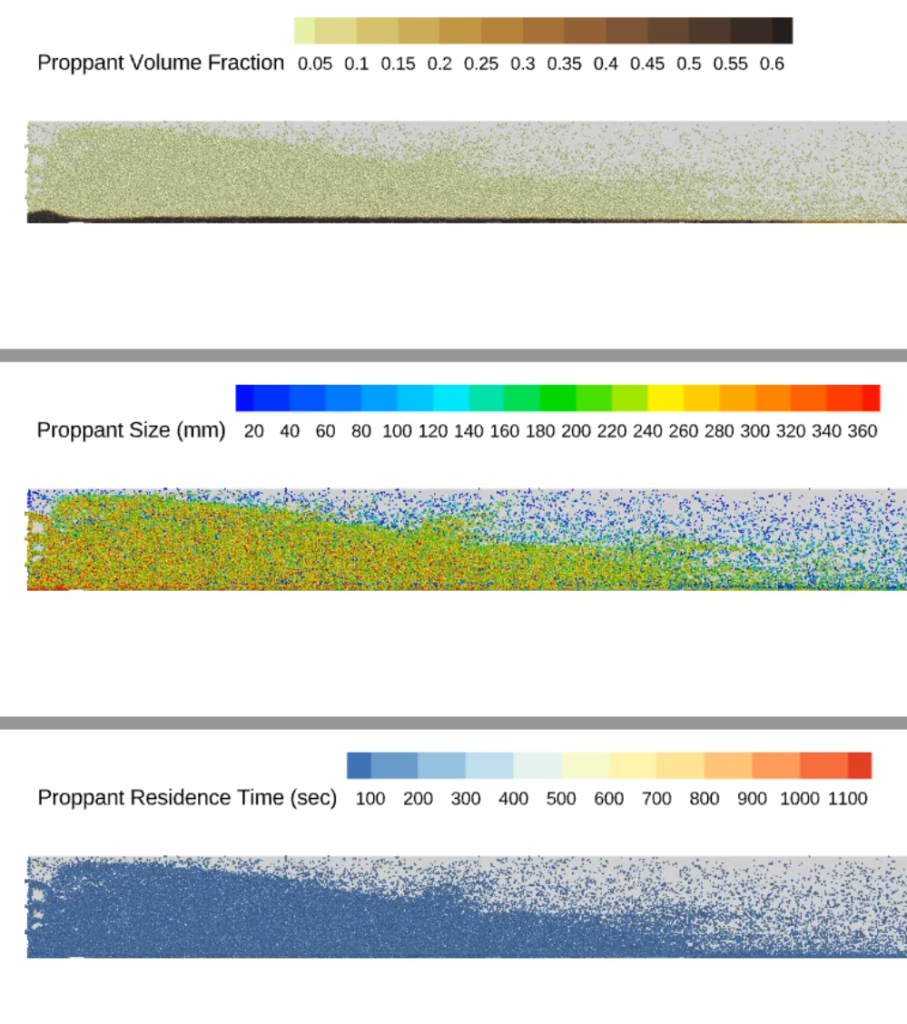
Hydraulic fracturing creates conductive pathways through unconventional reservoirs, but those pathways depend on proppant remaining distributed throughout the fracture after pumping stops. Proppant does not settle evenly along the fracture, instead accumulating more heavily near the injection point and forming a progressively thinner bed downstream. Understanding this heel-skewed distribution is important for evaluating how effectively a treatment can maintain fracture conductivity and reservoir contact.
This application model uses Barracuda Virtual Reactor to simulate proppant transport and settling in a single hydraulic fracture, including the interaction of a realistic proppant size distribution with slickwater. The model incorporates a user-defined non-Newtonian drag model to account for the shear-thinning behavior of the fracturing fluid, along with wall effects and particle-wall friction. The simulation is validated against experimental measurements of proppant-bed formation, providing a benchmark for Barracuda’s ability to capture the transport and settling behavior of proppant in a fracture.
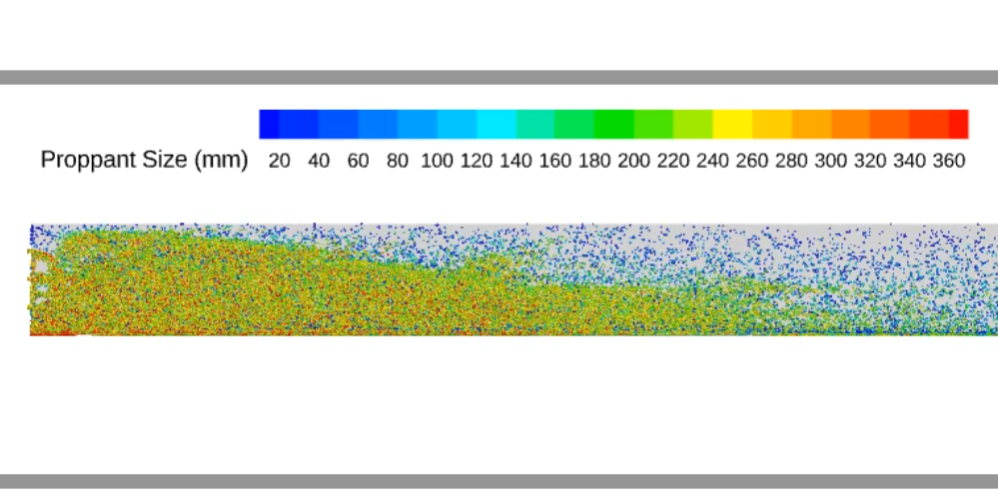
The simulation captures the development of the characteristic proppant bed, including size segregation as coarser particles settle closer to the injection point while finer particles travel farther downstream. The validated Barracuda results also provide training data for a Graph Neural Network reduced-order model (GNN-ROM), which closely reproduces the predicted bed profiles at a fraction of the computational cost. Together, these models provide a foundation for studying proppant placement and extending simulation approaches toward larger, multi-fracture completion designs.
Additional Resources