
EUBCE – May 19-22, 2022
For over 40 years, the European Biomass Conference and Exhibition – EUBCE has been a key platform for reflecting on the biomass sector’s evolution and exploring future trends in bioenergy…

For over 40 years, the European Biomass Conference and Exhibition – EUBCE has been a key platform for reflecting on the biomass sector’s evolution and exploring future trends in bioenergy…
ERTC: Ask The Experts isn’t just a conference—it’s a unique, interactive environment where your refinery’s most pressing technical questions get answered. Learn directly from leading refiners and technology providers solving real-world challenges. Get…
CPFD Software is pleased to announce that Dr. Peter Loezos, Vice President of Engineering, will be speaking at the European Refining Technology Conference (ERTC), taking place November 17–20, 2025, in Cannes, France.

ASIA’S MOST INFLUENTIAL DOWNSTREAM OIL AND GAS EVENT Against the global landscape of accelerating change throughout the oil & gas industry, the Asian Refining Technology Conference (ARTC) is the key…
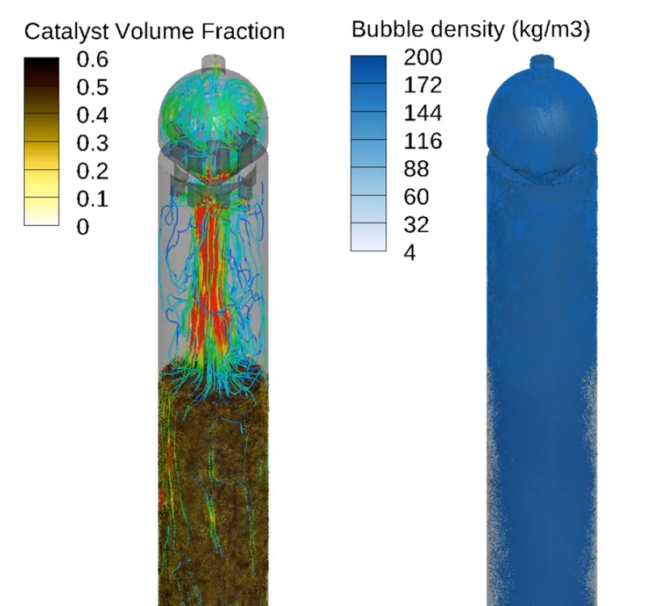
This video demonstrates the discrete bubble modeling feature introduced in Barracuda Virtual Reactor 22.1. The simulation models an ebullated bed reactor with a fluidized bed of catalyst particles in liquid phase domain, with discrete gas bubbles injected.
Beijing Hi-key Plus Technology Co. Ltd., CPFD Software’s distributor for Barracuda Virtual Reactor in the People’s Republic of China, has announced a series of online and in-person training courses for 2025
ERTC is taking place in Cannes, France on 17 – 20 November 2025. Join the global refining network as we discuss the short, medium, and long-term issues affecting the downstream…

CPFD Software are proud to once again sponsor the FCC Forum. This by-invitation-only event, hosted by Axens and Technip Energies, is dedicated to FCC Technology and its related topics. The…
Barracuda simulations, validated against literature experiments, were used to develop a simulation strategy for counter-current downers and evaluate a coupled riser–counter-current downer system, showing improved solids distribution and high solids holdup for enhanced gas–solid contact beyond the flooding point.
Barracuda simulations, validated against pilot-scale PIV experiments, were used to compare co- and counter-current downer hydrodynamics, showing that the counter-current configuration achieves 69% higher solids holdup and 98% longer residence time while providing a more uniform particle velocity profile.