
Also available on Youtube.
About This Webinar
Presented by:
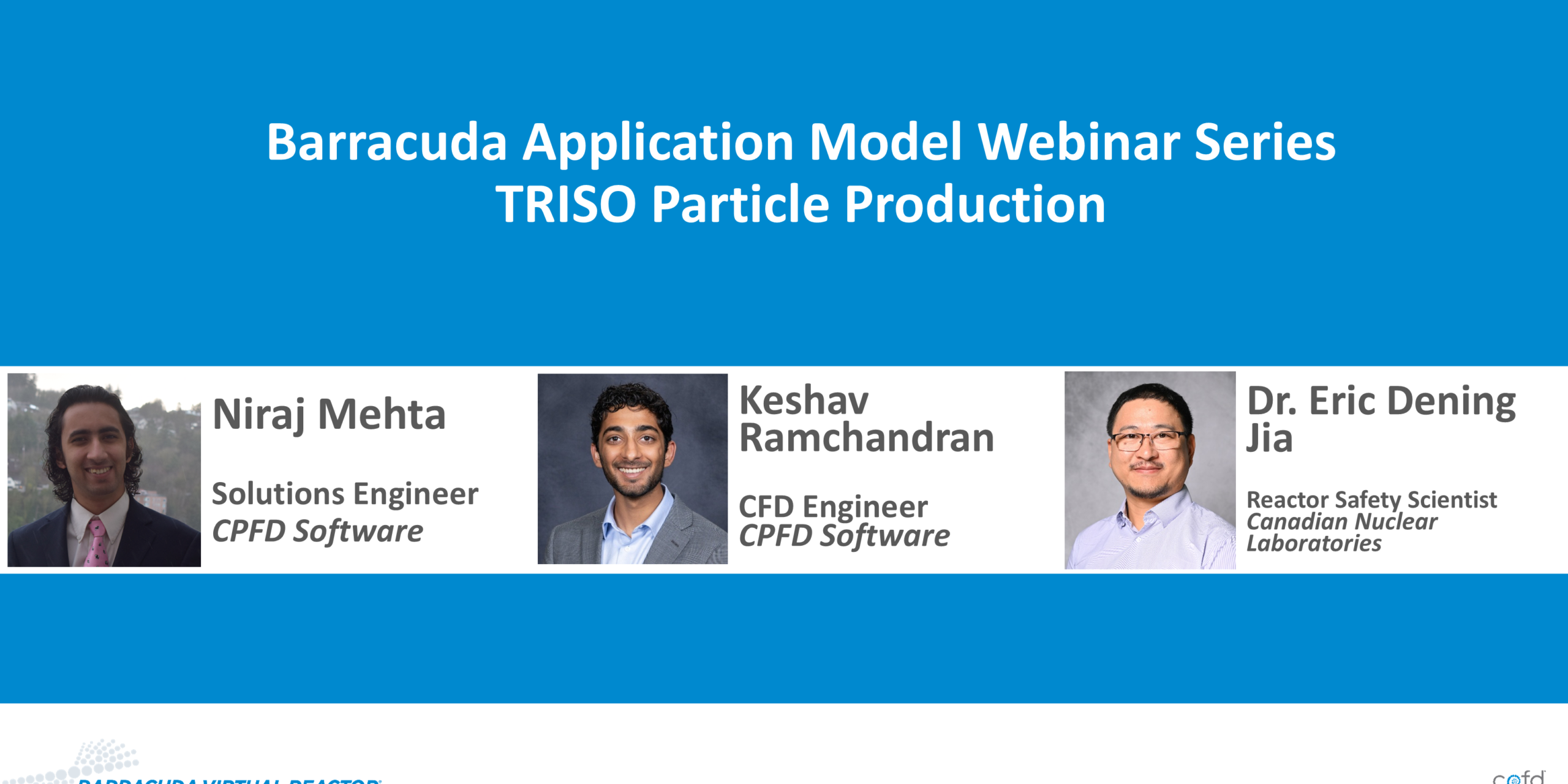
Dr. Eric Dening Jia – Reactor Safety Scientist, Canadian Nuclear Laboratories
Keshav Ramchandran – CFD Engineer, CPFD Software
CPFD Software’s Barracuda Application Model Webinar Series is designed to give engineers and researchers deeper insight into how Barracuda Virtual Reactor is applied to real-world challenges. Application models are sample cases that can be downloaded, run, and customized by the Barracuda Virtual Reactor user community.
TRISO (TRi-structural ISOtropic) fuel particles are a key technology for next-generation high-temperature gas-cooled nuclear reactors (HTGRs), offering improved safety, higher operating temperatures, and enhanced fuel integrity compared to conventional nuclear fuels. During fabrication, carbon and silicon carbide coatings are deposited onto fuel kernels inside spouted bed chemical vapor deposition (CVD) reactors, where complex gas–solid hydrodynamics, heat transfer, reaction kinetics, and particle growth behavior directly influence coating quality and process efficiency.
In this session Dr. Jia from the Canadian Nuclear Laboratories will provide an overview of advanced nuclear energy production and the role of TRISO particles. Then, CPFD’s Keshav Ramchandran, will introduce and demonstrate the TRISO Particle Production application model which captures dense particle fluidization and spouting behavior alongside hydrocarbon pyrolysis chemistry, soot precursor formation, and carbon deposition onto UO2 fuel kernels.
Application models are sample cases that can be downloaded, run, and customized by the Barracuda Virtual Reactor user community. This application model provides a practical foundation for studying TRISO coating reactor design, particle growth behavior, deposition uniformity, entrainment mitigation, and process optimization for advanced nuclear fuel manufacturing workflows.