
Application Model Overview
Cement manufacturers are increasingly looking to alternative fuels to reduce fossil fuel consumption and make beneficial use of waste materials. Municipal sludge is a promising option, but its high moisture content and different fuel characteristics introduce additional challenges for calciner operation. Drying, devolatilization, char combustion, and fuel-bound nitrogen chemistry must occur alongside coal combustion and raw-meal calcination.
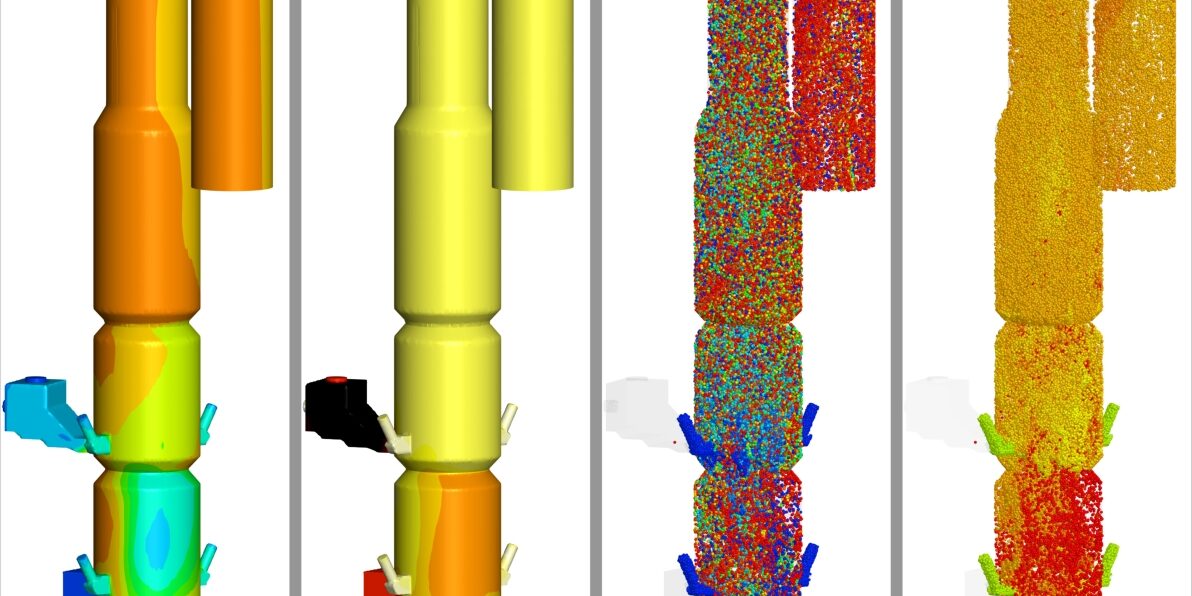
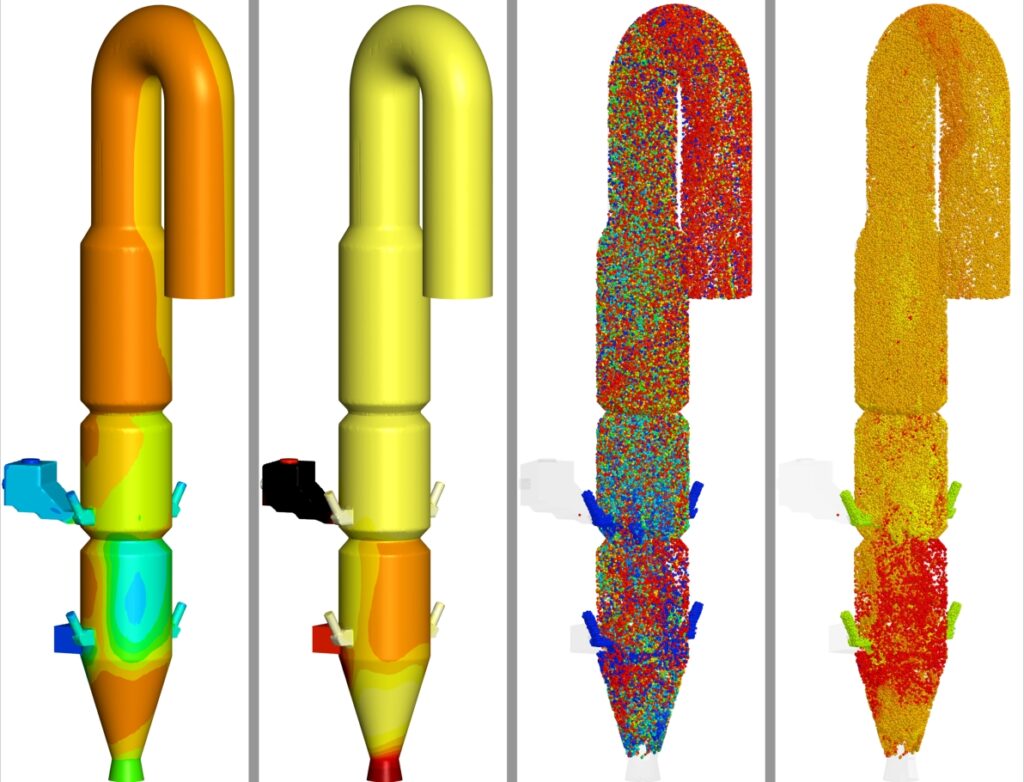
This application model extends CPFD Software’s industrial-scale cement calciner model to simulate co-firing with municipal sludge. Coal and sludge are represented separately, allowing their transport, heating, conversion, and burnout to be evaluated while accounting for their interactions with the gas phase and raw meal. The model incorporates sludge moisture evaporation, devolatilization, char oxidation, combustion, fuel-N/NOₓ chemistry, and limestone calcination within a coupled gas–particle simulation.
The model provides insight into how sludge substitution affects temperature, oxygen availability, fuel conversion, calcination, residence time, and emissions throughout the calciner. A 20% sludge substitution case predicts an outlet temperature of approximately 1112 K and 89% calcination, while revealing changes in the spatial distribution of combustion and NO formation. Users can build on this framework to investigate sludge properties, particle size, injection location, substitution level, and operating conditions for their own alternative-fuel applications.
Additional Resources