
Also available on Youtube.
About This Presentation
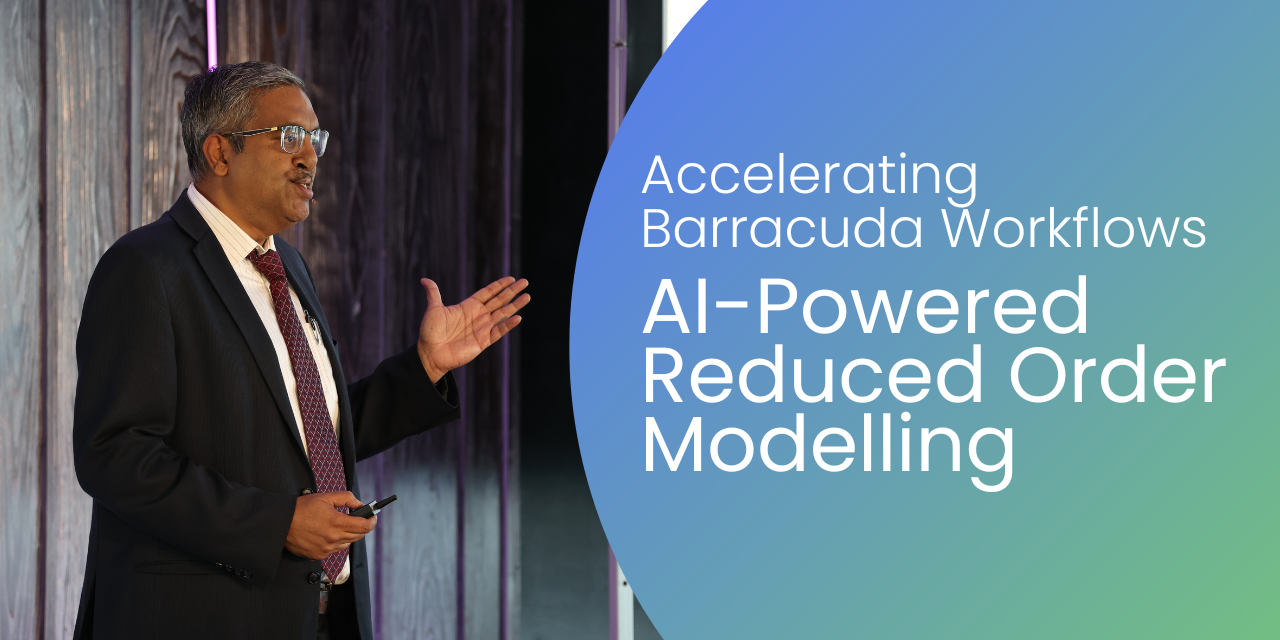
Presented by Saurav Mitra of CPFD at the 2026 Barracuda Virtual Reactor Users’ Conference.
High-fidelity CFD simulations provide valuable insight into complex multiphase systems but often require significant computational time, limiting their use for design optimization, parametric studies, and real-time decision making. This presentation introduces CPFD’s ongoing development of AI-powered Reduced Order Models (ROMs) that accelerate Barracuda Virtual Reactor simulations while preserving the fidelity of validated MP-PIC physics. The approach leverages graph neural networks to learn transient Eulerian and Lagrangian behaviors directly from Barracuda-generated data, enabling rapid prediction of particle volume fraction, species transport, and solids motion across unseen operating conditions and geometries. Validation studies spanning hydraulic fracture proppant transport, fluidized-bed gasification, fluidized beds, and spouted beds demonstrate strong agreement with full CFD while achieving speedups of up to 80–90× for field predictions and 35–40× for particle-cloud evolution. The presentation also discusses CPFD’s broader vision for integrating ROM technology into engineering workflows to support rapid design exploration, optimization, digital twins, and interactive analysis without replacing the underlying physics-based solver.
About the Speaker
Saurav joined CPFD in 2025 and develops AI-accelerated reduced-order modeling capabilities for Barracuda Virtual Reactor and Arena-flow. He has extensive experience in multiphase CFD, heat transfer, and physics-based machine learning across industrial applications. Saurav holds an MS in Mechanical Engineering from the University of Minnesota Twin Cities and an MS in Aerospace Engineering from Syracuse University.