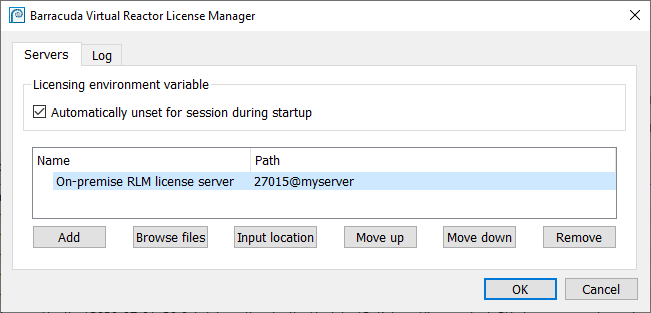
Point Clients to On-Premise RLM Server
This page contains instructions for pointing clients to an on-premise RLM server. The process is the same for both Barracuda Virtual Reactor and Arena-flow. The instructions below assume that you have already…

This page contains instructions for pointing clients to an on-premise RLM server. The process is the same for both Barracuda Virtual Reactor and Arena-flow. The instructions below assume that you have already…
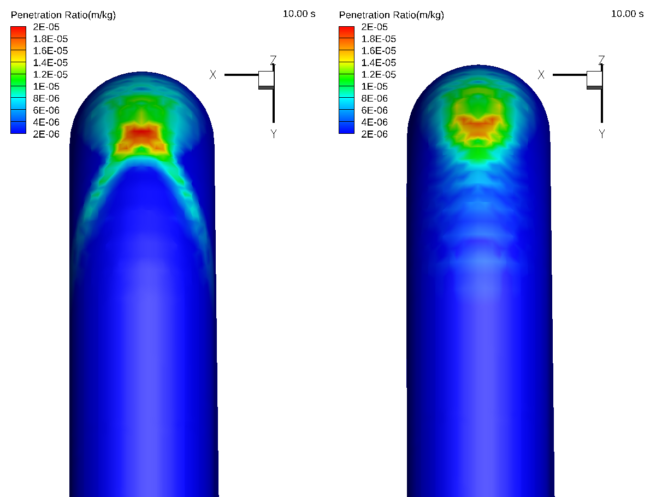
This application model uses Barracuda Virtual Reactor to simulate solid particle erosion in a 90-degree elbow, capturing particle-wall impacts and wear patterns under varying mass loadings. The simulation demonstrates how particle collisions influence erosion severity and distribution, enabling evaluation of component durability in particulate-laden flows.
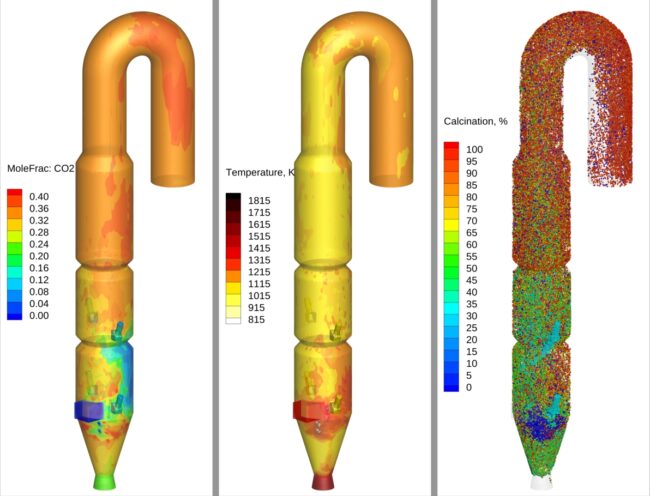
This application model provides a ready-to-use, literature-based reference for engineers studying calciner heat transfer, reaction kinetics, alternative-fuel co-processing, and carbon-capture-ready calciner designs using Barracuda Virtual Reactor.
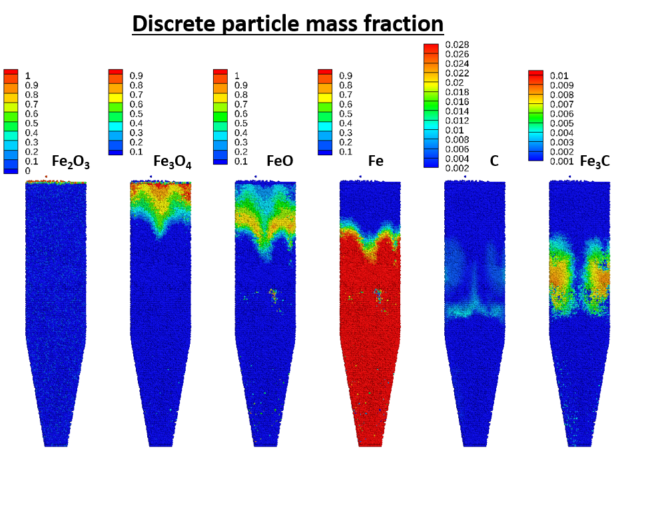
This application model uses Barracuda Virtual Reactor to simulate the direct reduction of iron ore in a MIDREX-style shaft furnace. The simulation tracks moving bed hydrodynamics and reduction reactions between iron oxide particles and a hydrogen–carbon monoxide gas mixture, enabling evaluation of solids conversion, gas species evolution, and furnace temperature profiles.
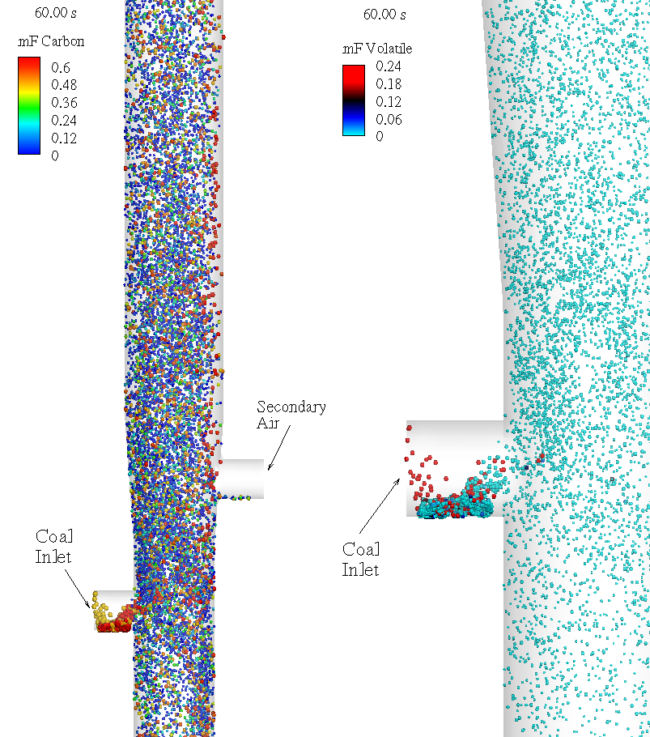
This application model uses Barracuda Virtual Reactor to simulate combustion inside the riser of a lab-scale CFB combustor. The simulation tracks fluid-particle interactions and chemical reactions between air and volatile species released from coal particles. This enables users to evaluate combustion performance, temperature profiles, and gas species distributions such as O₂, CO₂, NO, and SO₂ across the riser.
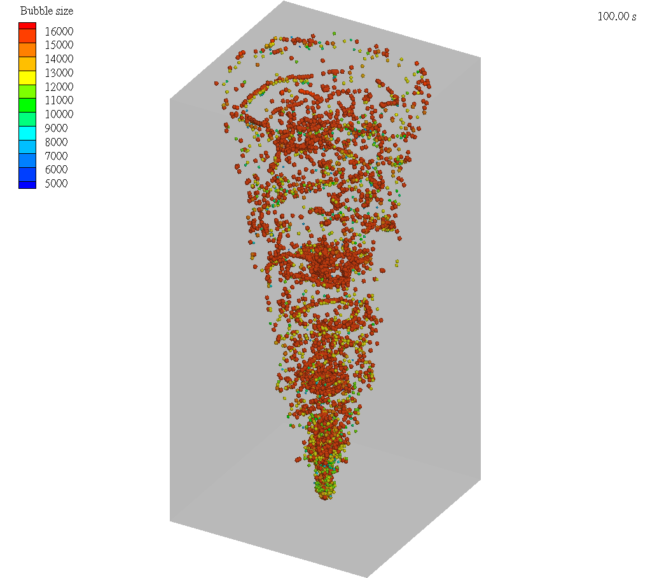
This application model uses Barracuda Virtual Reactor to simulate argon bubbles rising through molten iron in a laboratory-scale MMBCR. While chemical reactions are excluded in this study, the simulation captures detailed bubble behavior—tracking coalescence, breakup, and diameter evolution—as a foundation for modeling more complex reactive systems.
This application model uses Barracuda Virtual Reactor to simulate argon bubbles rising through molten iron in a laboratory-scale MMBCR. While chemical reactions are excluded in this study, the simulation captures detailed bubble behavior—tracking coalescence, breakup, and diameter evolution—as a foundation for modeling more complex reactive systems.
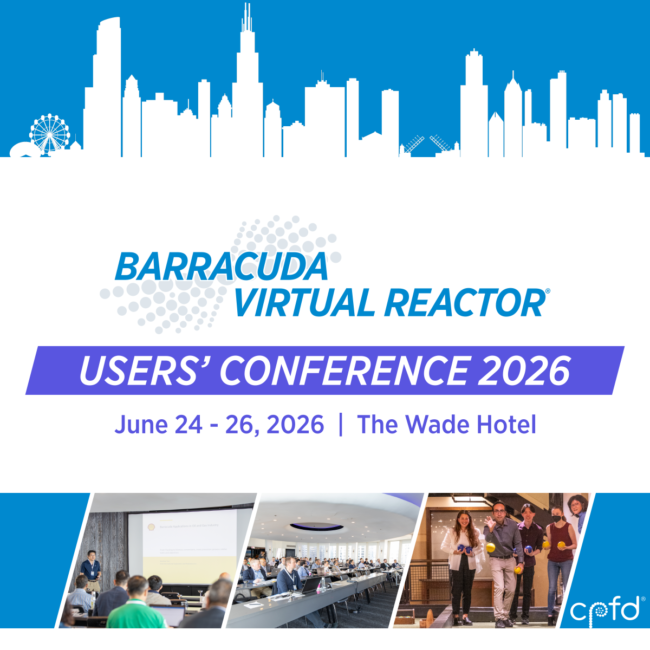
Join CPFD Software and the global Barracuda Virtual Reactor user community from June 24 – 26, 2026 at Barracuda Virtual Reactor Users’ Conference 2026 in Chicago, Illinois. The biennial conference…
CPFD Software’s Quarterly Newsletter for Q4 2025
CPFD Software’s Quarterly Newsletter for Q3 2025