
Application Model Overview
Sand production is a persistent challenge in oil and gas wells, where formation sand can erode equipment, accumulate in the wellbore, and reduce production. Sand screens are widely used to control this problem by allowing fluids and finer particles to pass while retaining coarser formation sand. Designing a screen that provides effective sand retention without unnecessarily restricting flow requires understanding how the full particle size distribution interacts with the screen.
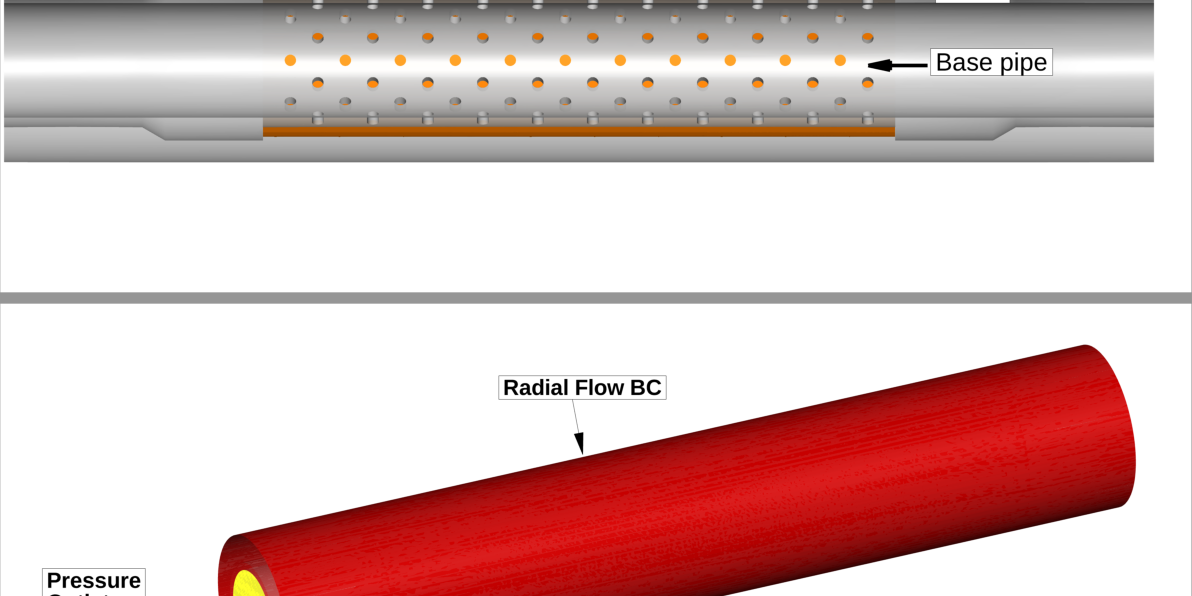
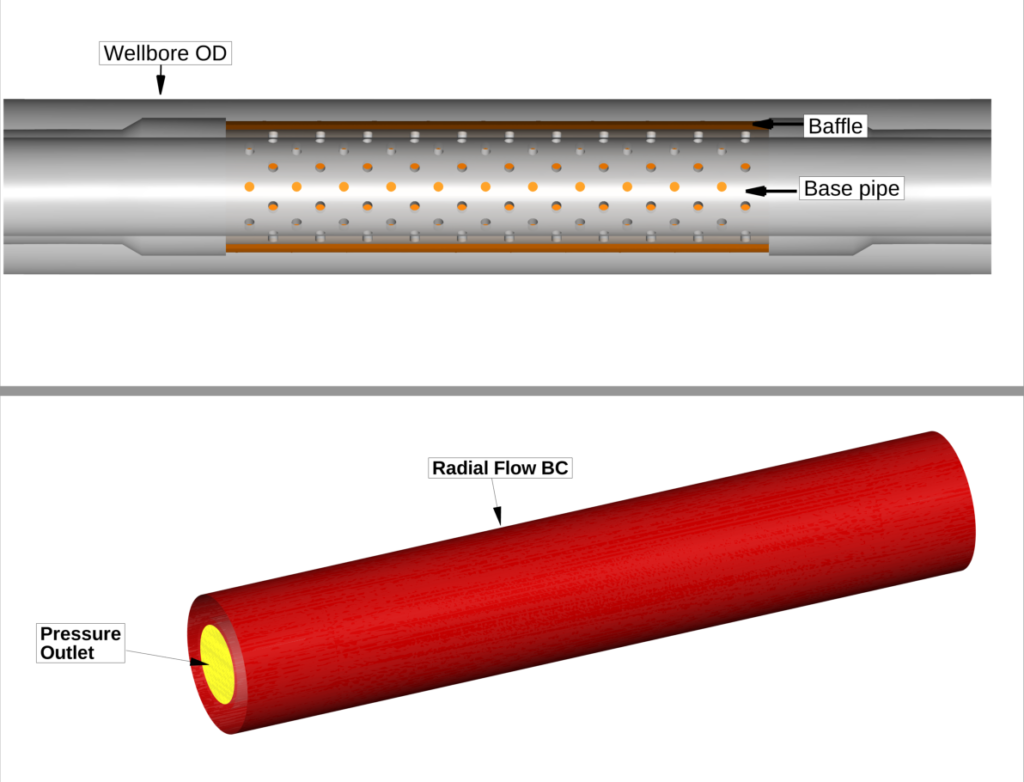
This application model uses Barracuda Virtual Reactor to simulate sand and water flowing through a downhole sand screen. Rather than resolving the screen’s individual slots or pores, the screen is represented as a baffle with a particle size-dependent passing probability, allowing different screen designs and filtration behaviors to be modeled efficiently. The model uses a realistic, polydisperse formation sand distribution and captures the size-dependent separation of particles as they approach and pass through the screen.
The simulation provides a quantitative view of screen performance by comparing the particle size distributions entering and exiting the screen. Results show that particles below the screen’s effective cut point pass through more readily, while larger particles are retained in the annular region. The model provides a framework for evaluating different formation PSDs and screen ratings and can support decisions around screen selection and sand-control strategies before deployment.
Additional Resources