
Application Model Overview
Ammonia is increasingly being considered as a carbon-free fuel for reducing CO₂ emissions from existing coal-fired power plants. Co-firing ammonia with coal offers a potential pathway to decarbonization without requiring replacement of existing combustion infrastructure, but introduces new challenges associated with nitrogen chemistry and NOx emissions.
This application model uses Barracuda Virtual Reactor to evaluate ammonia co-firing in a production-scale circulating fluidized bed (CFB) combustor. Building on previously validated pilot-scale and industrial-scale coal combustion models, the simulation evaluates ammonia substitution from 0–30% while maintaining a consistent underlying reaction mechanism and modeling approach throughout the scale-up process.
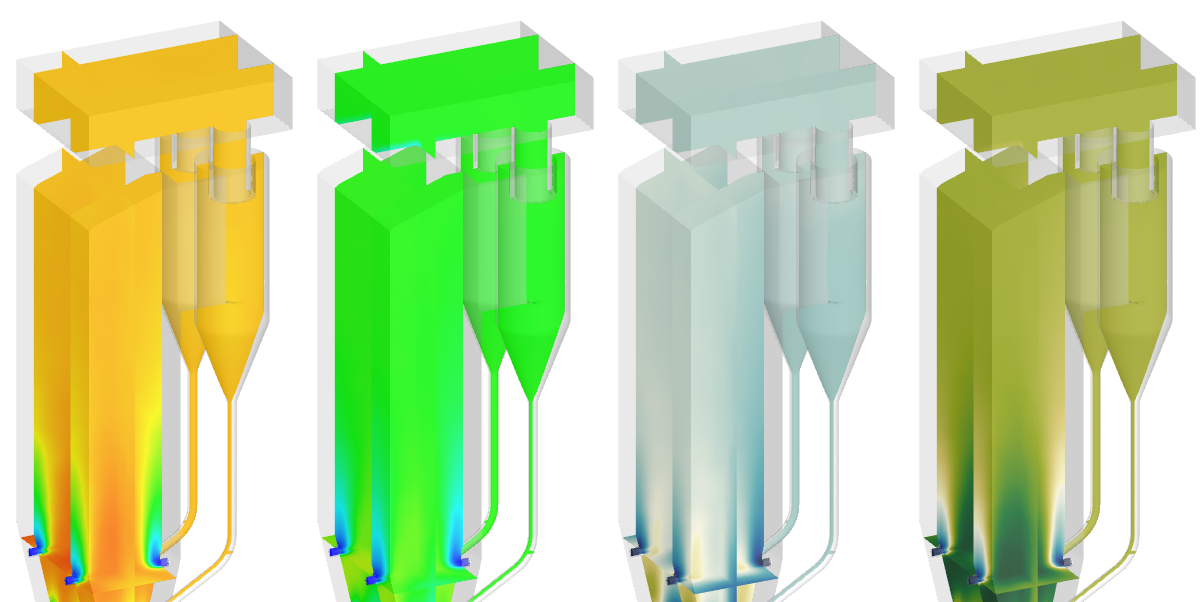
Simulation results demonstrate progressively lower CO₂ emissions as ammonia replaces coal, with the 20% co-firing case predicting a 32% reduction in outlet CO₂, closely matching published results. The model also captures increased H₂O production and the competing mechanisms governing NO formation and reduction, enabling users to evaluate the tradeoffs between decarbonization and NOx emissions when selecting an ammonia co-firing ratio.