
Introduction
Ammonia is increasingly recognized as a promising carbon-free fuel for reducing greenhouse gas emissions from coal-fired power generation. Unlike conventional fossil fuels, ammonia combustion produces no direct CO2 emissions, and because ammonia is already produced, stored, and transported at industrial scale for fertilizer and chemical applications, much of the infrastructure needed to handle it as a fuel is already in place, a major advantage over carbon-free alternatives that require infrastructure built from scratch.
As countries pursue carbon neutrality goals, ammonia co-firing has emerged as a practical near-term solution, allowing existing coal-fired plants to cut their carbon footprint without the capital expense and downtime of major retrofits. For companies currently operating coal-fired CFBs, this makes ammonia co-firing the most achievable pathway toward a lower-carbon process, and South Korea has already set ambitious targets along these lines. The Republic of South Korea has announced policies to reduce greenhouse gas emissions by approximately 290 million tons (40%) from baseline levels by 2030 [1], with its coal-fired power plants aiming to implement 20% ammonia co-firing, including the world’s largest coal-fired CFB in Samjang.
This momentum is backed by a growing body of experimental and numerical work. Recent studies [2] have shown that ammonia co-firing ratios up to 30% can be achieved in CFB combustors while preserving stable hydrodynamic behavior and combustion performance. Pressure distributions, temperature profiles, and solids circulation patterns remain largely unchanged as ammonia content increases, and the decarbonization scales directly with ammonia substitution, since ammonia contains no carbon. Simulations of a 50 kWth pilot-scale CFB show that a 30% ammonia co-firing ratio reduces CO₂ emissions by roughly 26% relative to conventional coal combustion, with additional emissions also decreasing because less coal is burned to meet the same heat demand. The tradeoff, however, occurs in nitrogen chemistry.
Ammonia’s high fuel-bound nitrogen content makes NO formation highly sensitive to the amount of co-firing present in the system. Ammonia plays a dual role: under the right conditions, unreacted ammonia participates in reduction reactions that convert NO back into nitrogen gas, but excess ammonia re-oxidizes in oxygen-rich zones, driving NO formation back up. Experimental and computational studies find that a 20% ammonia co-firing ratio is the operational sweet spot, delivering meaningful CO2 reductions without pushing NOx above conventional coal-combustion levels.
For energy suppliers, there is much work to be done before addressing emissions reductions. Developing a credible process requires establishing an underlying model that can be trusted in the first place and scaling that process up, finally tuning that industrial scale system to meet key emissions targets. In the Barracuda application model series, the same scale up process has been demonstrated for coal fed CFB’s, with this application model serving as the final simulation in the three-part series. All three simulations are built on the same model in Barracuda Virtual Reactor, using an MP-PIC framework and the same custom in-house reaction set throughout, so that differences across the series reflect changes in scale and operating conditions rather than inconsistencies in chemistry.
The first simulation validates the chemistry set against experimental data from a 50 kWth CFB pilot rig (bituminous coal, 1123 K, 1 atm), matching the temperature profile, O2/CO2 concentrations, and pollutant emissions before the model is considered validated. The second simulation carries the same validated chemistry into a full-loop, production-scale CFB boiler, scaling coal and air flow rates to the new diameter while holding superficial gas velocity constant, ensuring that solids circulation, combustion chemistry, and emissions are still accurately predicted at industrial scale while maintaining consistency in the underlying physics. Now, with a model that is both chemically validated and appropriately scaled, the third simulation introduces ammonia co-firing, evaluating NH3 substitution from 0–30% against the production-scale baseline and confirming, consistent with the literature, that 20% co-firing achieves roughly a 30% CO2 reduction without NOx overprediction. To access the previous simulations, click here for the pilot-scale simulation and here for the industrial-scale model.
Together, these three simulations reflect a validated, scaled, and optimized workflow rather than three independent case studies. This progression mirrors how users can realistically approach a CFD study of their own plant, first confirming the model against known pilot-scale behavior, then proving it holds at the scale of the actual asset, and only then using it to evaluate a proposed process change, such as ammonia co-firing, with confidence in the result.
The following results present findings from the third phase of this framework, detailing the axial species profiles and emission dynamics observed as ammonia substitution is progressively increased relative to the baseline commercial coal case.
Results
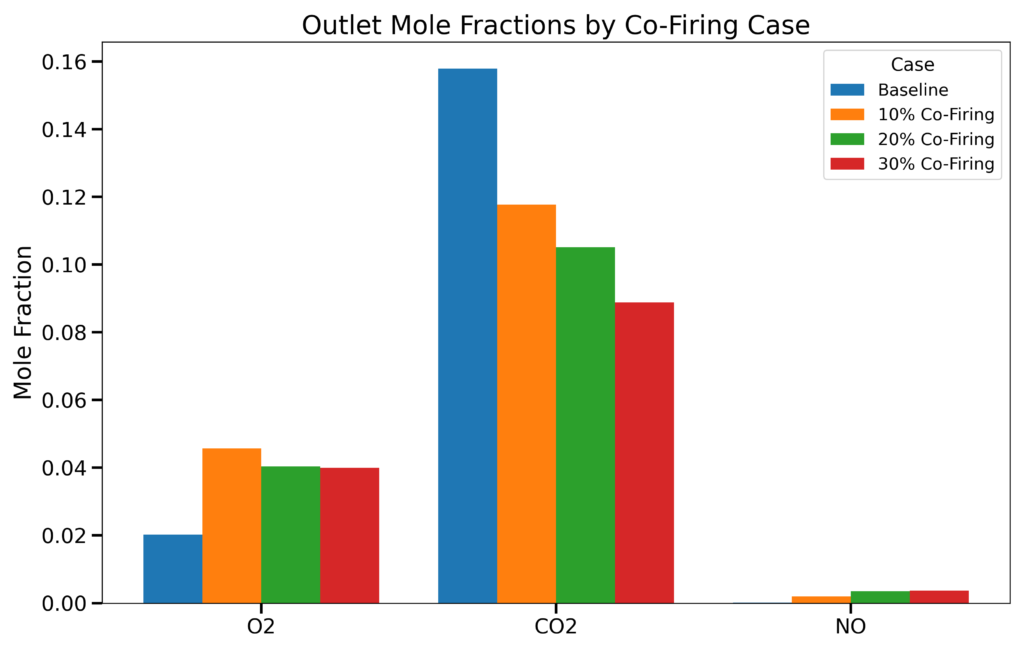
Figure 1: Outlet Mole Fraction Comparison for O2, CO2, and NO.
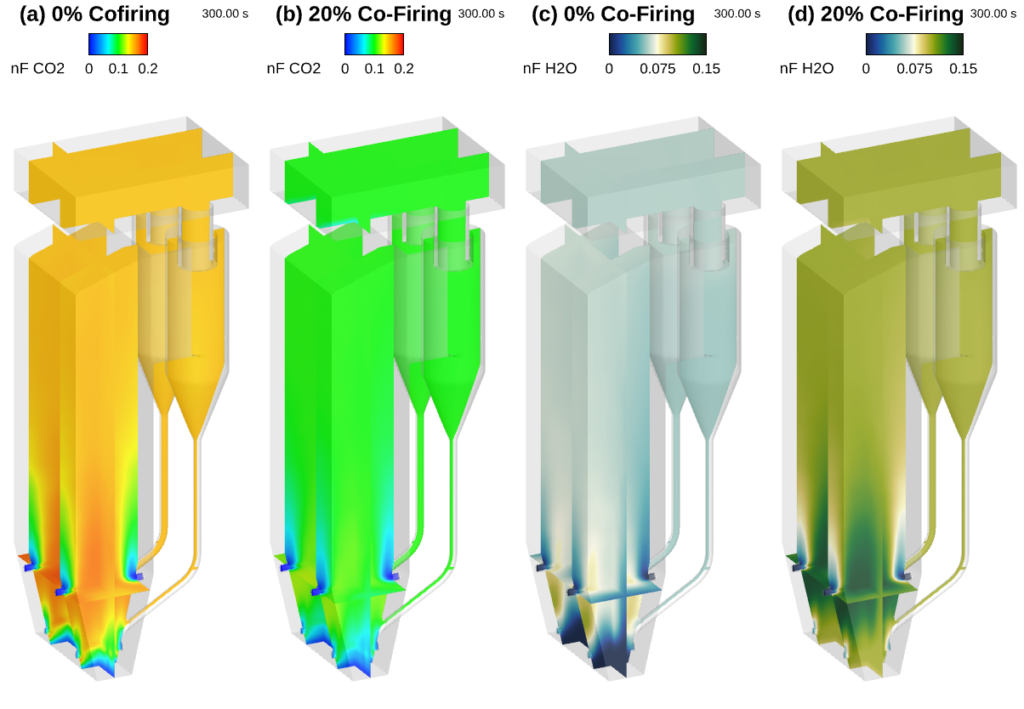
Figure 2: CO2 (a and b) and NO (c and d) Mole Fraction Comparisons for 20% Ammonia Co-Firing and 0% Ammonia Co-Firing
The Barracuda simulations examined the axial mole fractions of key gas species from 0 to 30 meters along the riser of the CFB furnace across four cases. These included a coal only baseline and three ammonia co-firing cases at 10%, 20%, and 30%. For each case, the mole fractions of O2, CO2, NO, and H2O were tracked, with the primary goal of reducing CO2 relative to the baseline. Figure 1 compares the resulting outlet mole fractions across all four cases, and the trend is immediately apparent. CO2 decreases steadily as the ammonia co-firing ratio increases. The baseline case yields an outlet CO2 mole fraction of roughly 15.5%, consistent with typical CFB operating ranges. Replacing 10% of the coal feed with ammonia lowers this to approximately 11.5%, a 25.5% reduction. At 20% co-firing, the Barracuda simulation predicts a 32.3% reduction in CO2, corresponding to an outlet mole fraction of 10.5%, closely matching the 33% reduction reported by Kweon et al. (2026) [2] for the same case. At 30% co-firing, the reduction reaches 42% relative to baseline.
The contour plots in Figure 2 show how ammonia co-firing changes the time-averaged gas mole fractions across the full CFB geometry at 300 seconds. In the CO2 contours, the 0% co-firing case shows yellow and orange regions throughout the dense bed and lower riser, reflecting the high carbon oxidation rate from coal alone. The 20% co-firing case shifts toward green and blue colors across the same region, indicating a clear drop in the CO2 mole fraction as ammonia replaces part of the coal feed. The H2O contours show the opposite trend. The 0% co-firing case remains mostly light blue/green throughout the reactor, reflecting low moisture generation due to coal’s limited hydrogen content, while the 20% co-firing case shows sustained green coloring through the dense bed and riser, reflecting the higher water vapor output from ammonia’s hydrogen-rich combustion. Overall, the contours confirm the same trends seen in the outlet compositions, with co-firing producing a visibly cleaner carbon signature at the cost of higher moisture content in the flue gas.
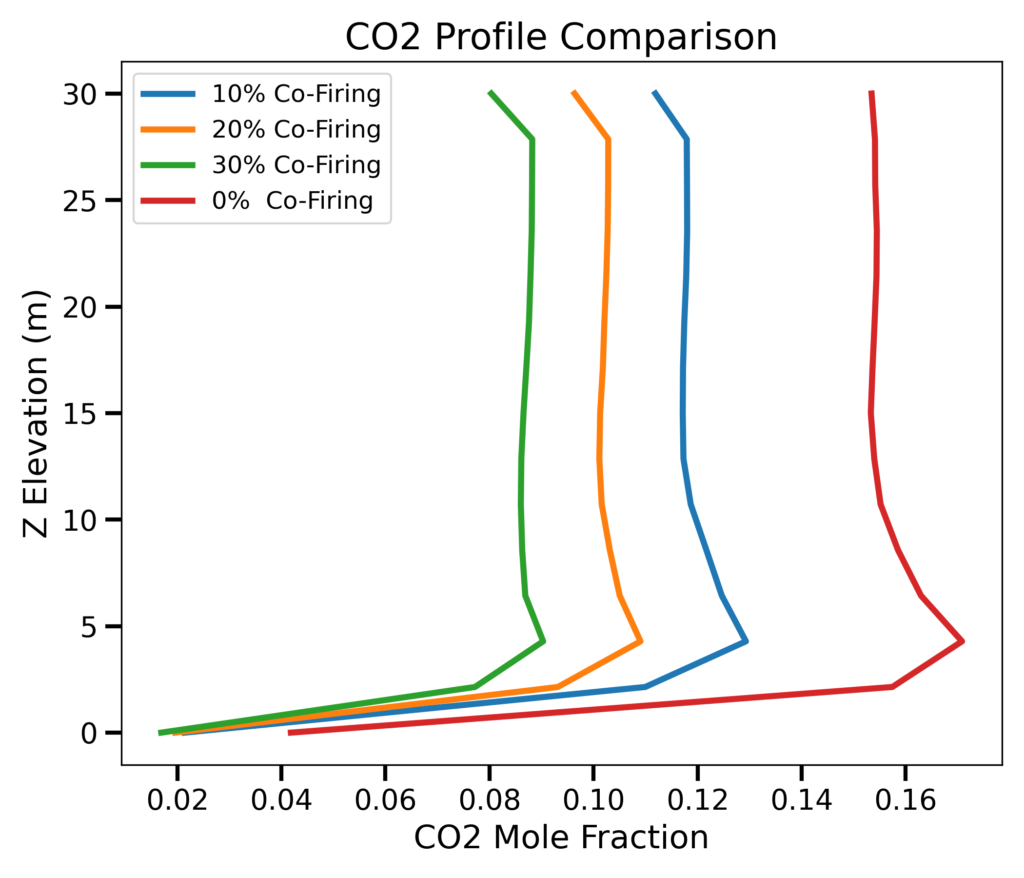
Figure 3 : Mole Fraction CO2 vs. Elevation for 0%, 10%, 20%, and 30% Ammonia Co-Firing.
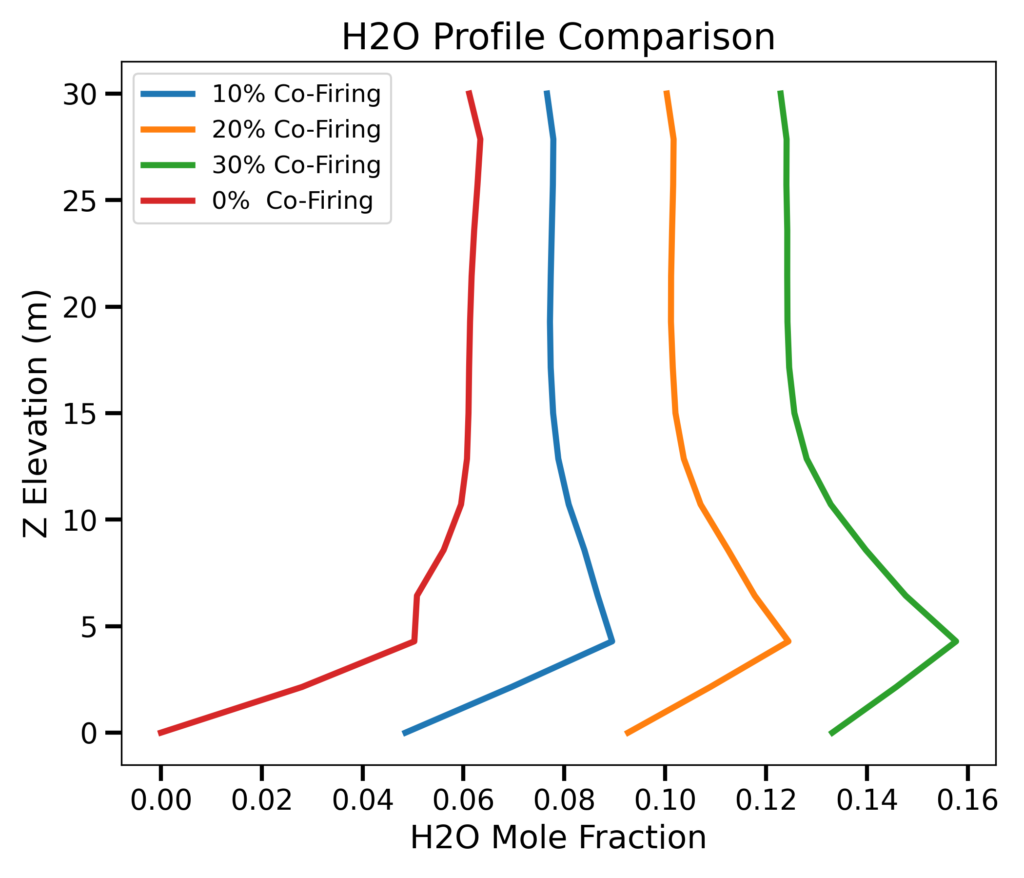
Figure 4: Mole Fraction of H2O vs. Elevation with 0%, 10%, 20%, and 30% Ammonia Co-Firing.
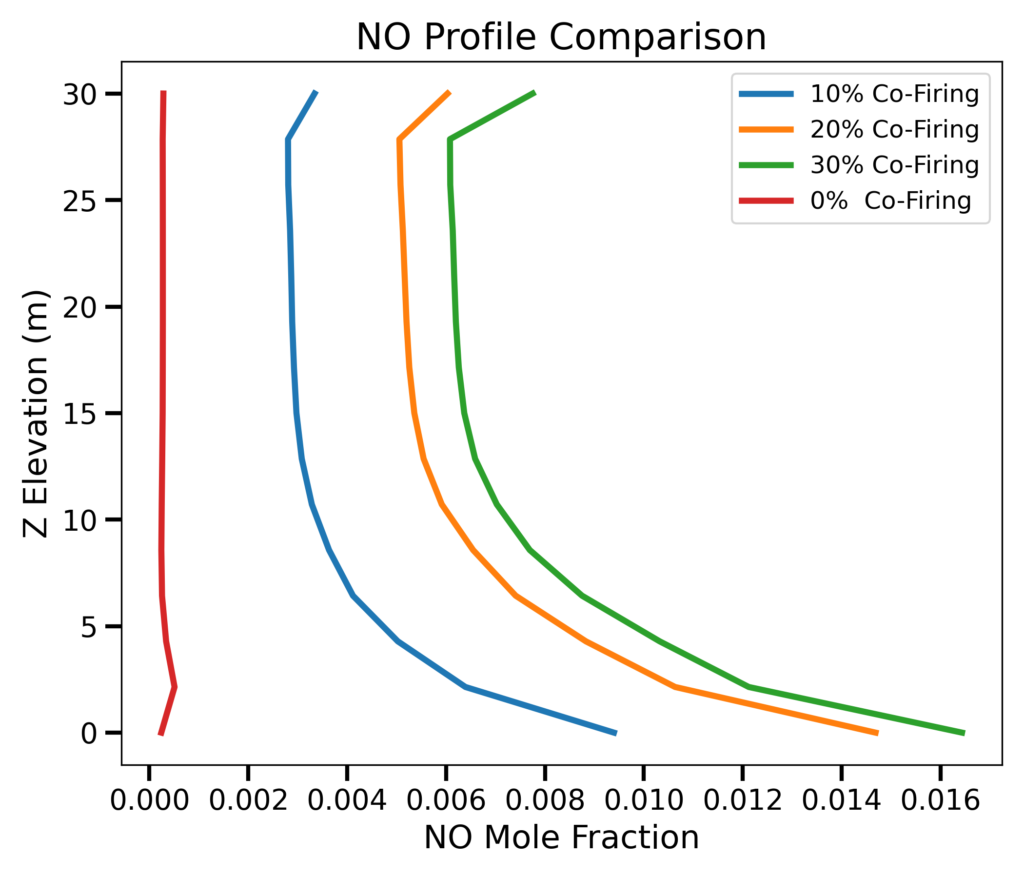
Figure 5: Mole Fraction of NO vs. Elevation with 0%, 10%, 20%, and 30% Ammonia Co-Firing.
Axial profiles of gas species mole fractions tell a similar story as the contour plot of Figure 2. Figure 3 shows the CO2 mole fraction as a function of riser elevation, with each case exhibiting a distinct, uniform decline in CO2 generation from the base of the furnace to the outlet as the ammonia ratio increases. This behavior follows directly from the chemistry in the riser. Coal is rich in carbon, and its oxidation, the source of the reactor’s heat release, produces CO2 and CO as the dominant carbon-bearing products. By replacing a portion of the coal feed with gaseous ammonia, the amount of oxidizable carbon entering the system is reduced accordingly, shifting combustion toward a less carbon intensive pathway while the overall heat balance is maintained.
This CO2 reduction is accompanied by corresponding shifts in the remaining gas species, most notably in moisture generation and nitrogen oxide emissions. Because ammonia is a hydrogen-rich fuel, its oxidation increases water vapor output. Figure 4 shows H2O mole fraction rising proportionally with the ammonia co-firing ratio throughout the riser, with the 30% case producing the highest H2O concentration at the outlet, scaling with ammonia’s growing share of the thermal input.
The NO profile, shown in Figure 5, reveals a more consequential trade off. In the baseline case, NO mole fractions remain low throughout the riser because coal’s nitrogen content is present only at trace levels as a volatile component. Introducing ammonia changes this picture significantly, as its fuel bound nitrogen rapidly oxidizes to NO in the hot, oxygen-rich dense bed region at the base of the riser (Z = 0 to 5 m), producing an immediate spike in NO concentration. From Z = 5 m to 30 m, NO declines steadily and asymptotically as the gas rises through the freeboard, reflecting active reduction mechanisms, primarily heterogeneous NO reduction over unburned coal particles and reactions with local reducing species. However, these reduction pathways aren’t sufficient to fully offset the large initial NO generation given typical riser residence times, so outlet NO mole fractions still scale directly with the ammonia feed rate, peaking in the 30% co-firing case. Taken together, these results show that while ammonia co-firing is highly effective at decarbonizing coal combustion, it places a greater burden on downstream NOx abatement. This means the optimal operating condition must balance CO2 and NO reduction simultaneously rather than maximizing one at the expense of the other.
The support file for the 20% ammonia co-firing case can be downloaded here, with all inputs necessary to run and reproduce the included results already input in the model setup.
References
-
Kim, Kyeong-Ho, et al. “Carbon-Free Ammonia Co-firing in Fluidized Bed Combustion: Analysis of Advanced Chemical Modeling and Detailed Mechanism.” ACS Omega, vol. 10, 2025, pp. 32712–27. ACS Publications, https://doi.org/10.1021/acsomega.4c10736.
-
Kweon, Joonwoo, et al. “3D Modeling of Ammonia Co-firing in a 50 kWth CFB Test Rig: NO Pathways and Environmental Implications for Carbon-Free Power Generation.” Energy, vol. 344, 2026, p. 139863. ScienceDirect, https://doi.org/10.1016/j.energy.2025.139863.